
JULY 2024
Is our participation necessary to counteract backward-looking ai?
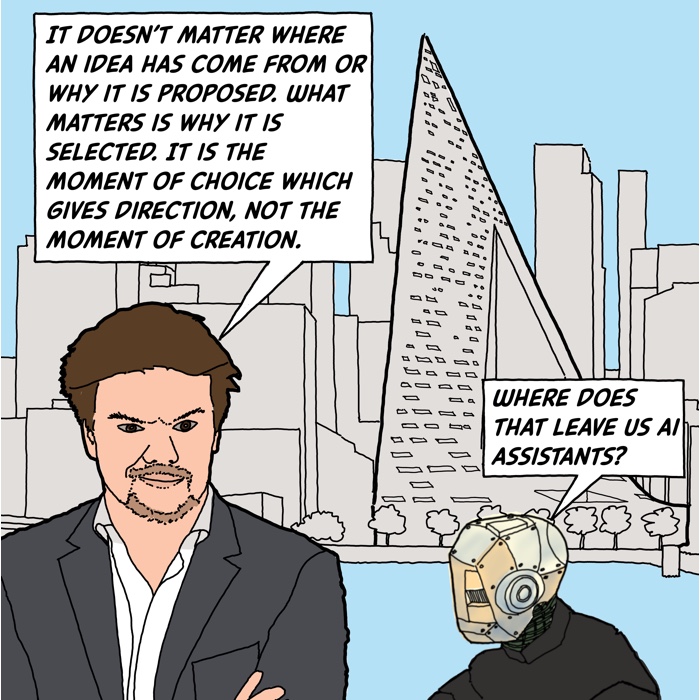
We are seeing a lot of speculation about the influence ai may have on the practice of architecture. It is understandable that there is a lot of focus on how ai may replace/ augment/ supplement human work. However there doesn't seem to be as much analysis of how ai might function in the context of how design actually happens.
Speaking with the Time Sensitive podcast team in 2019, the architect Bjarke Ingels noted "It doesn't matter where an idea has come from or why it is proposed. What matters is why it is selected.". Ingles goes on to say "It is the moment of choice which gives direction, not the moment of creation.".
In those three sentences Ingels neatly sums up the iterative design process necessary for complex designs. We need to put forward design propositions so that we can discover the questions we need to ask. By asking those questions we can then get a better understanding of the issues to be resolved. We need to canvass widely for propositions so that we can discover possibilities we haven't thought of. Having done that we then need to decide the best direction to take.
Most discussions about AI focus on the creative potential of those technologies- the "ideas" of Ingels' podcast. But we then need to decide which idea should be progressed- the "moment of choice". Is it us humans who then decide which solution represents the path forward? Or do we again harness AI to help us do that?
But even before we get to that point, we have to acknowledge there are limitations in using AI for the creation of ideas. AI relies on existing knowledge and understanding. Therefore AI responses reflect what has been, not what could be.
To explore the latter will need us humans to participate. Our emotions, curiosity, our subjectivity and prejudices, our analogical thinking, all are essential to progressing the design from that rooted in past experience to possibilities not previously imagined.